Department of High Energy Physics, Wigner RCP
Detection of forward protons and the study of central exclusive production.
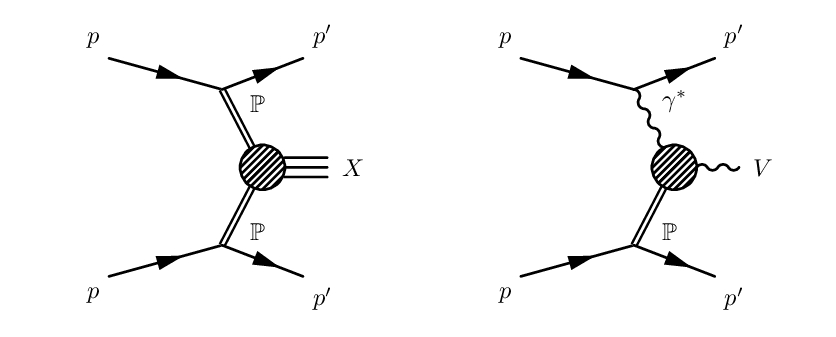
Central exclusive production (CEP) in proton–proton collisions provides a uniquely clean environment to study nonperturbative QCD dynamics, as the interacting protons remain intact and the centrally produced system is separated by large rapidity gaps. In such processes, the exchange of colorless objects—typically modeled as pomerons—dominates, making CEP particularly sensitive to diffractive mechanisms and multi-pomeron interactions (Fig. 1). The detection of forward protons is therefore essential, as it allows full kinematic reconstruction of the event and strong background suppression. Dedicated forward detectors, such as the TOTEM Roman Pot detectors, play a crucial role in enabling these measurements.
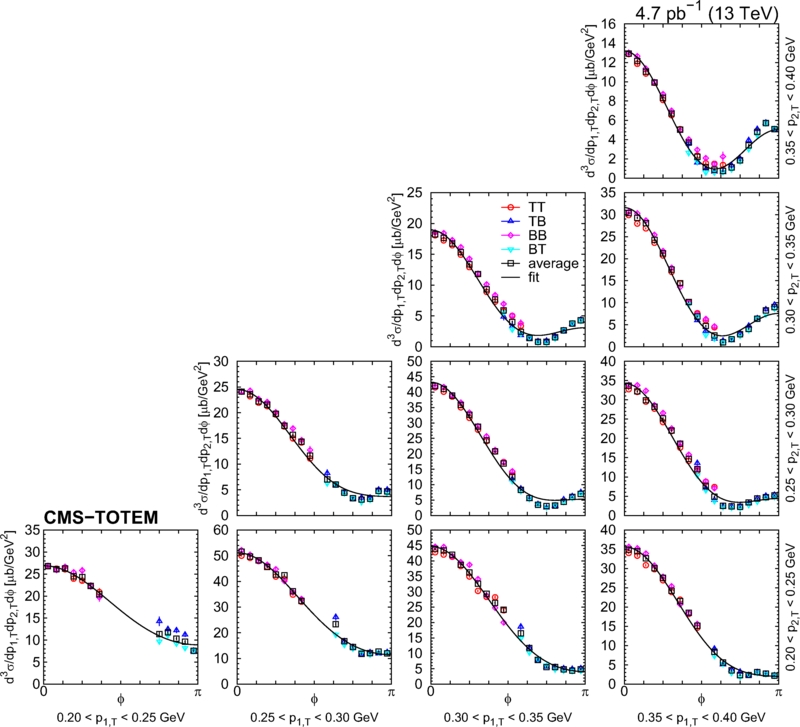
We have published the paper on the nonresonant central exclusive production of charged-hadron pairs in proton–proton collisions at √s = 13 TeV [1,2]. A rich structure of interactions related to double-pomeron exchange is observed. A parabolic minimum in the distribution of the two-proton azimuthal angle is observed for the first time (Fig. 2). It can be interpreted as an effect of additional pomeron exchanges between the protons, arising from the interference between the bare and the rescattered amplitudes.
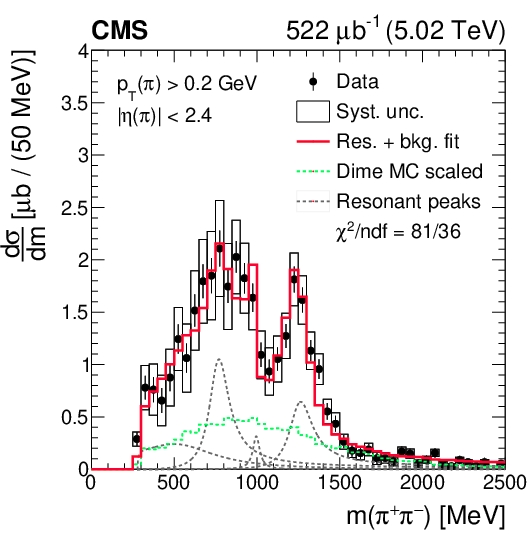
We published a paper on the central exclusive and semi-exclusive production of π+π− pairs measured with the CMS detector in pp collisions at center-of-mass energies of √s=5.02 and 13 TeV [3]. The theoretical description of these nonperturbative processes, which have not yet been measured in detail at the LHC, poses a significant challenge to models. The two pions are measured and identified in the CMS silicon tracker based on specific energy loss, whereas the absence of other particles is ensured by calorimeter information. The total and differential cross sections of exclusive and semi-exclusive central π+π− production are measured as functions of invariant mass, transverse momentum, and rapidity of the π+π− system in the fiducial region defined as transverse momentum pT,π > 0.2 GeV and pseudorapidity |ηπ|<2.4 (Fig. 3). The production cross sections for the four resonant channels f0(500), ρ0(770), f0(980), and f2(1270) are extracted using a simple model. These results represent the first measurement of this process at the LHC collision energies of 5.02 and 13 TeV [4].
We have optimized proton reconstruction with the TOTEM Roman Pot detectors for high-β* LHC data [5], aiming for an optimal reconstruction tool for central exclusive physics analyses. The alignment of the Roman pot system is performed through time-dependent adjustments, resulting in a position accuracy of 3 μm in the horizontal and 60 μm in the vertical directions.
[1] CMS and TOTEM Collaborations, Phys. Rev. D 109 (2024) 112013
[2] Siklér F [CMS and TOTEM Collaborations], IJMP A (2024) 2444001
[3] CMS Collaboration, Eur. Phys. J. C 80 (2020) 718
[4] Surányi O (CMS), PoS ICHEP2020, 508 (2020)
[5] CMS and TOTEM Collaborations, JINST 20 (2025) 04012