Department of High Energy Physics, Wigner RCP
Scaling properties of light and heavy-flavor jets
We studied the structure of jets in proton-proton collisions at LHC energies using Monte Carlo simulations. We demonstrate that the radial jet profiles exhibit scaling properties with charged- hadron event multiplicity over a broad transverse-momentum range. Based on statistically motivated parametrizations of the jet profiles, we proposed that the scaling behavior stems from fundamental statistical properties of jet fragmentation. We also observed that the charged-hadron multiplicity distributions scale with jet momentum (Fig. 1). This suggests that the Koba–Nielsen–Olesen (KNO) scaling holds within a jet. The in-jet scaling is fulfilled without MPI, but breaks down in case MPI is present without color reconnection. Our findings imply that KNO scaling is violated by parton shower or multiple-parton interactions in higher-energy collisions [1].
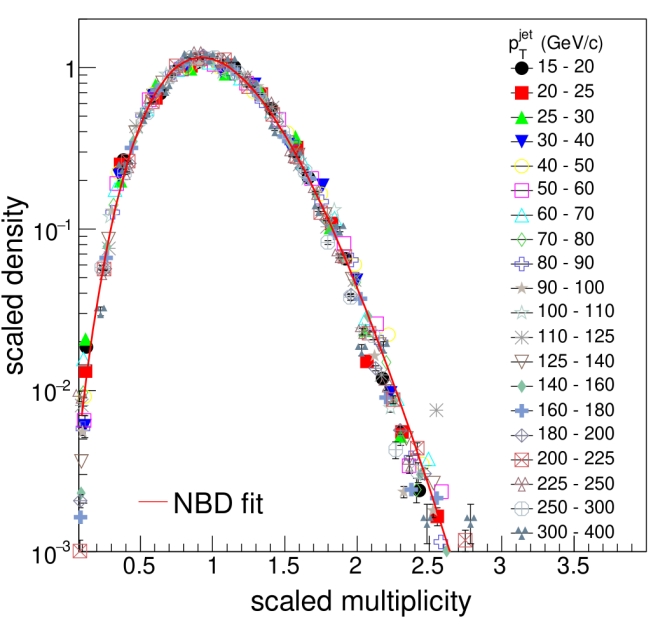
In a subsequent publication we investigated the scaling properties of heavy-flavor jets using Monte-Carlo simulations. We found that while jets from leading-order flavor-creation processes exhibit flavor-dependent patterns, heavy-flavor jets from production in parton showers follow inclusive-jet patterns. This suggests that KNO-like scaling is driven by initial hard parton production and not by processes in the later stages of the reaction [2].
Jet substructure and fragmentation studies with ALICE and CMS
The Koba-Nielsen-Olesen (KNO) scaling hypothesis is an influential contribution to the analysis of event multiplicities in high-energy particle collisions, according to which the event-multiplicity distributions can be all collapsed onto a universal scaling curve. Recent phenomenological studies suggest that a similar scaling may hold within single jets, if we consider the jet multiplicity as a function of the jet transverse momentum. We have been working on the first measurement of this scaling for single jets in proton-proton collisions at √s=13 TeV with ALICE, which can help further our understanding of jet fragmentation properties.
We analyze the intrinsic structure of the jets recorded by the CMS. By studying a large sample of data obtained by various triggers from 2017, we were able to obtain information on the extreme corners of the phase space. The promising preliminary studies include the corresponding systematic uncertainties and the results are compared to various model predictions. The ongoing studies include the comparison of the measured results with various model predictions.
Thermodynamical string fragmentation and string density effects in jets
It has been proposed to search for thermal and collective properties arising from parton-fragmentation processes by examining high jet charged-constituent multiplicities (Nj,ch) in proton-proton collisions. Previous studies did not reveal any conclusive evidence for the presence of radial flow. We expanded upon the proposed Monte Carlo study by eliminating selection biases associated with triggering on charged particle multiplicities. Furthermore, MPI are disabled to focus exclusively on jet fragments. We analyze pp collisions at √s=13 TeV simulated with PYTHIA 8, exploring different implementations of the generator: thermodynamical string fragmentation and the standard Lund fragmentation model. The impact of color-string junctions was also explored. Surprisingly, the thermodynamical string fragmentation together with the close-packing of strings mechanism predicts a hint of baryon enhancement in jets (Fig. 2).
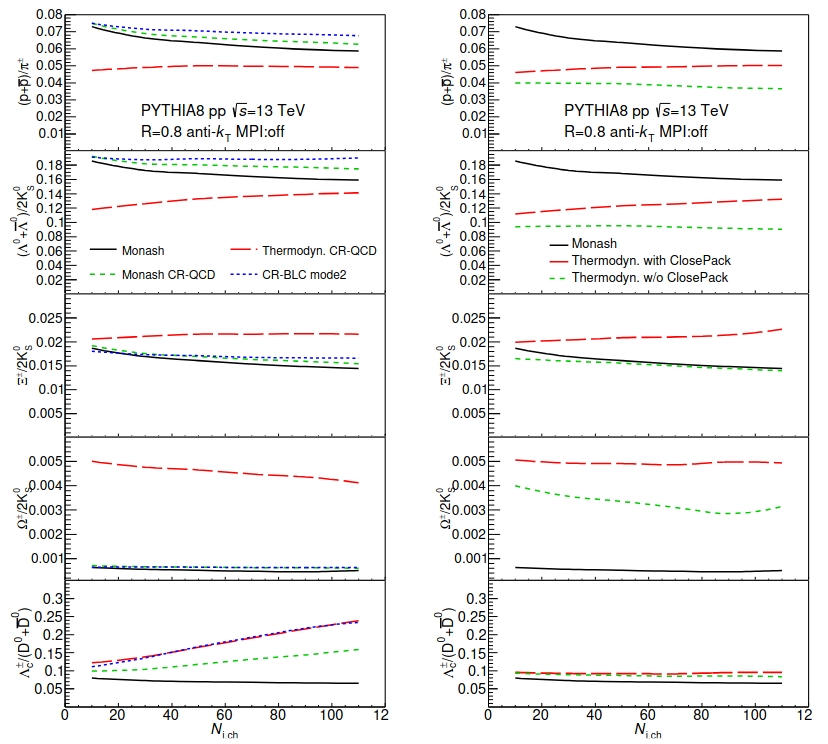
Additionally, the light-flavor baryon-to-meson ratios as a function of jT exhibit similarities across all PYTHIA 8 implementations, and hint at radial flow-like effects. In contrast, the ratio of heavy-flavor hadrons (Λc+/D0) at low jT as a function of Nj,ch shows a trend similar to that observed as a function of charged-particle multiplicity in minimum-bias data, suggesting that color-string junctions may play a crucial role in heavy baryon production in jets. The same mechanism also predicts a jT-integrated Λc+/D0 ratio that increases with increasing Nj,ch. Interestingly, for the lowest Nj,ch value, such a ratio is consistent with the e+e− limit, suggesting that jet multiplicity is a potential way to explore more dilute systems covering the multiplicity gap between e+e− and pp collisions. [3].
[1] Vértesi R, Gémes A, Barnaföldi G G, Phys. Rev. D 103 (2021) 051503
[2] Varga Z, Vértesi R, Symmetry 14 (2022) 1379
[3] Vértesi R. Ortiz A., Phys.Rev.D 112 (2025) 3, 036009