Department of High Energy Physics, Wigner RCP
Heavy and Light flavor on the Tsallis-thermometer
Evolution of the hot dense matter at LHC energies with the Tsallis-thermometer. — We analyzed the transverse momentum distributions of the identified D mesons from pp, p-A and A-A collisions in the ALICE and STAR experiments covering the center-of-mass energy range between 200 GeV and 7 TeV, within a non-extensive statistical framework. We found that D mesons, which are created in the early stages of a collision, generally follow the trends observed for light-flavor hadrons but they correspond to a higher Tsallis temperature and and the heavy-flavor spectra are produced at earlier stages of the collision. [1].
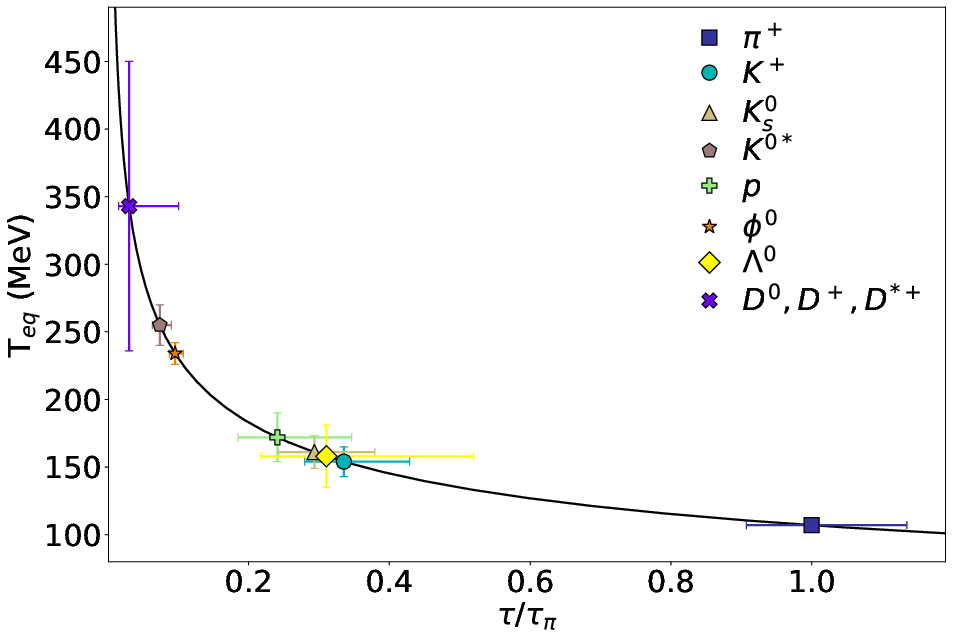
We also analyzed the transverse momentum distributions of the identified light- and heavy-flavour hadrons from pp, p-Pb and Pb-Pb collisions in the ALICE experiment, covering the center-of-mass energy range between 2.76 TeV and 13 TeV, within the same non-extensive statistical framework. We found that formation of mesons is mass ordered, with heavier particles formed in earlier stages of collisions. Baryons, on the other hand, were found to be formed at later timescales compared to mesons with similar masses (Figure 1). We determined that the spectrum formation proper time of pions is significantly larger compared to all the other hadrons: ~3 times of kaons and ~33 times that of D mesons. We also estimated the heat capacity of the system based on the common non-extensivity parameter and relative fluctuation values, which yielded a system-wide lower boundary C>5. The upper limit corresponding to light mesons implies a largely thermalized system, while heavier hadrons are strongly non-extensive regardless of the system size. [2].
Effect of event classification on the Tsallis thermometer. — As a continuation of our study we analyze identified hadron spectra in pp collisions at √s = 13 TeV measured by ALICE, classified by multiplicity, flattenicity, and spherocity. The spectra were fitted with the Tsallis-Pareto distribution, and the parameters were studied on the Tsallis-thermometer. Multiplicity and flattenicity classes follow a previously observed scaling, while the non-extensivity parameter shows a distinct sensitivity to the spherocity. A data-driven parametrization confirms a proportionality between the Tsallis temperature and mean transverse momentum, offering a simple estimate of the effective temperature. These results highlight the ability of the Tsallis-thermometer to capture both multiplicity and event-shape effects, linking soft and hard processes in small systems [3].
[1] Gyulai L, Bíró G, Vértesi R, Barnaföldi G G, J.Phys.G 51 (2024) 085103
[2] Gyulai L, Bíró G, Vértesi R, Barnaföldi G G, Int.J.Mod.Phys.A 40 (2025) 09, 2444010
[3] Gyulai L, Bíró G, Vértesi R, Barnaföldi G G, Phys.Rev.D 113 (2026) 1, 016021